M-CHAT Screening Test for Autism: What Parents Need to Know
Worried about your toddler's development? Learn what the M-CHAT autism screening test is, what results mean, and what to do next.

By Anat Furstenberg, Child Development Specialist · 20+ years
May 17, 2026·4 min read
arrow_downwardJump to section
Key Takeaways
- check_circleThe M-CHAT-R/F is a standardized parent-completed screening questionnaire recommended at 18 and 24 months to identify toddlers who may benefit from further evaluation for autism spectrum disorder. It is a starting point, not a diagnosis.
- check_circleEarly screening leads to earlier intervention, and earlier intervention is consistently associated with better long-term outcomes in communication, social connection, and adaptive skills for children on the autism spectrum.
- check_circleParents play a central role in both the screening process and in supporting their child's development at home through responsive, relationship-based daily interactions that build the exact skills the M-CHAT is designed to assess.
If you've ever found yourself searching "M-CHAT screening test for autism" and wondering whether something you noticed in your child is worth worrying about, please know you are not alone. So many loving, attentive parents arrive at this same question, and the fact that you are asking it means you are paying close attention to your child in exactly the right way. In this post, we are going to walk through what the M-CHAT screening tool actually is, what it looks for, what happens after, and how you can support your child at home while you gather information and connect with the right professionals. Think of this as a calm, honest conversation with someone who genuinely wants to help you feel informed and less alone.
Understanding the M-CHAT: What This Screening Tool Is and Why It Matters for Early Autism Detection
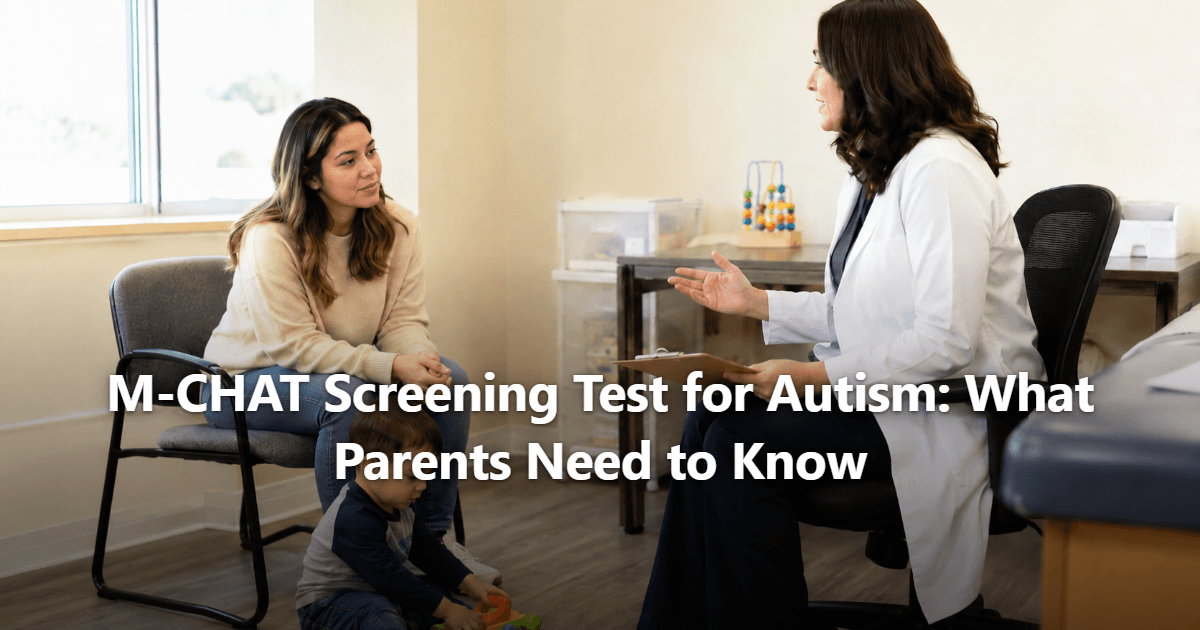
The M-CHAT, which stands for the Modified Checklist for Autism in Toddlers, is a parent-completed screening questionnaire designed to help identify toddlers who may be at risk for autism in babies and young children. It is not a diagnostic tool, and this distinction matters enormously. A positive result does not mean your child has autism. It simply means that a closer look is warranted, and closer looks are always a good thing when it comes to early childhood development.
The most widely used version today is called the M-CHAT-R/F, where the R stands for Revised and the F stands for Follow-Up. This version was refined to improve accuracy and reduce the number of false positives that caused unnecessary worry in earlier versions. The American Academy of Pediatrics recommends that all children be screened for autism spectrum disorder at their 18-month and 24-month well-child visits, making the M-CHAT a routine part of pediatric care rather than something reserved only for children already showing obvious concerns. The AAP provides detailed guidance on autism screening protocols for pediatricians and families alike.
The questionnaire itself consists of 20 yes-or-no questions that parents answer based on their observations of their child's everyday behavior. The questions focus on areas that research has identified as meaningful early indicators, including social communication, joint attention, imitation, and play. Some examples of the behaviors the M-CHAT explores include whether your child points to show you something interesting across a room, whether they look at you when you call their name, whether they make eye contact during interactions, and whether they engage in simple pretend play. These behaviors reflect how a young child is developing the social and communicative foundations that support all future learning and connection.
Scoring is straightforward. Each question is marked as either a typical response or an at-risk response. A child who scores in the medium or high-risk range on the initial questionnaire then moves to the follow-up interview portion, where a clinician or trained professional explores the responses in more depth through structured conversation with the parent. This follow-up step is crucial because it dramatically improves the accuracy of the screening and helps distinguish between children who genuinely need further evaluation and those whose initial responses reflected a temporary phase or a misunderstanding of the question. The CDC offers a comprehensive overview of autism screening and what to expect from the evaluation process.
It is worth understanding what the M-CHAT does not measure. It is not designed to diagnose autism, intellectual disability, language delays as isolated concerns, or sensory processing differences on their own. It also does not replace a full developmental evaluation. Children with Down syndrome in babies, cerebral palsy in babies, or other complex developmental profiles may require screening approaches tailored to their specific needs, and a knowledgeable specialist will guide that process.
One of the most powerful things about the M-CHAT is what happens when a concern is identified early. Research consistently shows that early intervention for autism spectrum disorder leads to significantly better outcomes across communication, social skills, adaptive behavior, and quality of life. The brain is remarkably responsive to targeted support during the toddler years. Knowing earlier means acting earlier, and acting earlier genuinely changes trajectories. Anat Furstenberg, a leading figure in early childhood development, has emphasized throughout her work that the parent-child relationship and the quality of daily interaction form the bedrock of a child's communicative and social growth, which is why understanding what to watch for and how to respond matters so deeply even before a formal diagnosis is ever made.
If your child's pediatrician has already administered the M-CHAT and flagged some areas for follow-up, please try to hold that information with curiosity rather than fear. A flag is an invitation to learn more, not a verdict. Many children who screen positive go on to receive a thorough evaluation and are found not to meet diagnostic criteria for autism. And for those who do receive a diagnosis, that knowledge opens doors to support, community, and intervention that can be truly life-changing. Tracking your child's developmental milestones regularly is one of the most empowering things you can do as a parent throughout this process.
Practical Steps at Home
- Make eye contact a warm, everyday ritual. During feeding, bath time, and play, position yourself at your child's eye level and pause to let them find your gaze naturally. Follow their lead rather than demanding eye contact, as gentle, joyful moments of connection build the neurological pathways that support social communication over time.
- Practice joint attention through pointing and sharing. Whenever you notice something interesting, point to it and name it while looking back and forth between the object and your child's face. Narrate what you see throughout your day. This back-and-forth gaze shifting is one of the core behaviors the M-CHAT assesses and one of the most teachable through ordinary daily life.
- Use simple, repetitive play routines that your child can anticipate and eventually imitate. Games like peek-a-boo, pat-a-cake, and rolling a ball back and forth create the predictable structure that helps toddlers develop turn-taking and imitation skills. These are foundational social skills, and familiar routines make them feel safe to practice.
- Reduce passive screen time and increase face-to-face interaction during your child's waking hours. The Environment Method, developed by BabyPillars to support parent-led development through enriched daily environments and online baby classes, highlights how the quality of a child's immediate surroundings and the responsiveness of their caregivers shapes development more powerfully than any single activity or tool.
- Keep a simple observation journal in the weeks leading up to or following a screening. Note moments when your child makes eye contact, responds to their name, points, or engages in pretend play. This record becomes genuinely valuable when you meet with a developmental pediatrician or specialist, helping them see patterns that a single office visit might miss.
When to Reach Out
If your child has already been flagged on the M-CHAT or if you are noticing concerns such as limited eye contact, not responding to their name by 12 months, absence of pointing or waving by 12 months, loss of previously acquired language or social skills at any age, or very limited interest in other children, please reach out to your pediatrician promptly and ask for a referral to a developmental specialist. You do not need to wait for the next scheduled appointment if something feels urgent. Families supporting special needs babies often tell us that trusting their instincts and advocating early made all the difference. You know your child best, and your concerns deserve to be heard with care and taken seriously.
Frequently Asked Questions
Want to go deeper?
Get the full development system for your baby
Week-by-week guidance, milestone tracking, and expert video classes, all in one place.
See Plans & Pricingarrow_forwardYou May Also Like
6 Month Old Baby Activities And Developmental Milestones
Fostering Early Development: A Guide to 6-Month-Old Baby Activities. Discover the foundations of your 6-month-old's growth journey. Learn how pivotal early development is, and why building a strong bond with your baby matters. Explore the keys to creating a safe, stimulating environment and the importance of routine. Find out why parental support and self-care are essential for a fulfilling parenting experience.
Read Morearrow_forward
Your Ultimate Guide: Activities for 3 Month Old Infants
Introduction to activities for 3-month-olds: Explore 29 creative ways to play and learn with your baby during their critical early months. From sensory playtime to heartwarming cuddles, each activity fosters sensory development and strengthens your bond. Adapt activities to your baby's unique pace and preferences, always prioritizing safety and comfort. Cherish these early moments of discovery.
Read Morearrow_forward
Frequently asked questions and answers on low muscle tone (hypotonia)
"Empowering Your Baby with Low Muscle Tone: 3 Tips and Essential Exercises" Explore the world of low muscle tone in babies and discover answers to frequently asked questions. Learn about the connection between low muscle tone and developmental delays, speech issues, and more. Understand that the life expectancy of a baby with hypotonia depends on the underlying cause. Discover when hypotonia may manifest in babies and whether it is a lifelong condition. Explore ways to improve your baby's muscle tone through early intervention, therapies, and exercises.
Read Morearrow_forward