Baby Not Making Eye Contact? What Parents Should Know
Worried your baby isn't making eye contact? Learn what it may or may not mean, including autism signs, and what you can do to help your little one today.

By Anat Furstenberg, Child Development Specialist · 20+ years
May 4, 2026·3 min read
arrow_downwardJump to section
Key Takeaways
- check_circleLimited eye contact alone is not a diagnosis of autism or any other condition. It is a meaningful signal that deserves attention within the full context of your baby's development.
- check_circleThe quality of early parent-baby interaction directly shapes how social communication skills develop, making responsive, emotionally available caregiving one of the most powerful tools available.
- check_circleEarly observation and early support lead to the best outcomes. Trust your instincts, track developmental milestones, and reach out to your pediatrician or a developmental specialist if something concerns you.
If you've noticed that your baby isn't making eye contact, your heart is probably doing that quiet, anxious flutter that so many parents know well. First, please take a breath. Asking this question shows how deeply you are paying attention to your little one, and that attentiveness is one of the greatest gifts you can offer. This post will walk you through what we know about eye contact in babies, what it may or may not signal, how the parent-baby relationship shapes early communication, and what you can do at home starting today. You will also find guidance on when to bring in professional support, because you should never have to figure this out alone.
What Eye Contact Really Tells Us About Your Baby's Development
Eye contact is one of the earliest and most meaningful forms of communication a baby can offer. Long before words arrive, a baby's gaze is a whole conversation. It says, "I see you. I am here with you." When that gaze seems absent or inconsistent, it is completely natural for parents to wonder what it means, including whether it could be a sign of autism in babies.
The honest answer is that limited eye contact on its own is not a diagnosis. It is a signal worth paying close attention to, and it can have many different causes. Some babies are more visually sensitive and find prolonged eye contact overwhelming. Some are simply taking longer to tune into social cues. Others may have underlying differences in development that benefit from early support. What matters most is looking at the whole picture, not a single behavior in isolation.
From a developmental perspective, we know that social communication begins incredibly early. Even in the first weeks of life, babies are learning to connect through gaze, tone of voice, touch, and movement. A baby who is responded to warmly and consistently begins to understand that their signals matter, and that understanding becomes the foundation of all future communication. The CDC notes that most babies begin making eye contact within the first few months of life, and that changes in social engagement are worth discussing with a pediatrician.
What is equally important to understand is that the quality of early interaction shapes how eye contact develops. When a caregiver is emotionally present and responsive, a baby learns that looking at another person's face is rewarding and safe. When there are disruptions in that early dance, whether due to parental stress, family circumstances, or the baby's own sensory differences, eye contact can be one of the first things to reflect that disruption. This does not mean a parent has done anything wrong. It simply means that the relationship itself is the most powerful therapeutic tool available.
Anat Furstenberg, a leading voice in the field of infant development, has long emphasized that communication development is deeply rooted in the emotional availability of caregivers and the quality of movement-based interactions in early life. This is why approaches that support both the parent and the baby together tend to produce the most meaningful results.
It is also worth noting that limited eye contact can appear in children with a range of developmental profiles, including Down syndrome in babies and cerebral palsy in babies, as well as in children who are developing typically but are simply more introverted or sensory-sensitive. This is why a comprehensive evaluation from a trained professional is so much more informative than any single checklist. Tracking your baby's developmental milestones over time gives you and your care team a much clearer picture than any one moment can provide.
Early intervention, when needed, makes a profound difference. Research consistently shows that the earlier a child receives targeted support, the better their long-term outcomes. The American Academy of Pediatrics recommends developmental surveillance at every well-child visit and formal screening at 18 and 24 months specifically for autism spectrum disorder. If something feels off, trust that instinct and bring it to your pediatrician sooner rather than later.
Practical Steps at Home
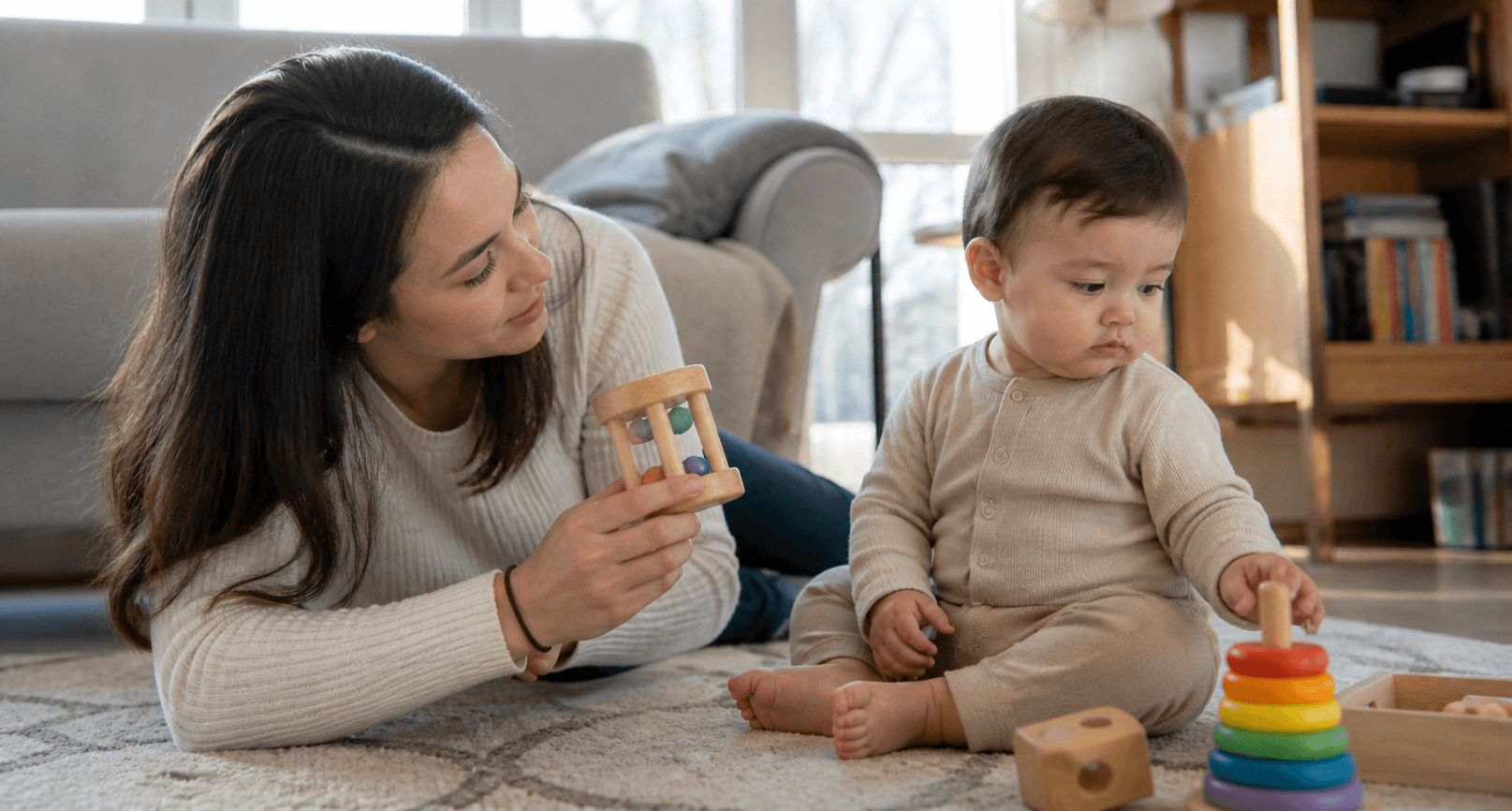
- Get face to face, at baby's level. Position yourself so your face is within 20 to 30 centimeters of your baby's face during calm, alert moments. This is the optimal distance for a young baby's vision. Speak softly, pause, and give your baby time to look toward you without pressure.
- Follow your baby's lead before drawing their attention. Instead of calling your baby's name repeatedly to get them to look at you, try observing what they are already interested in and joining them there first. Comment gently on what they are doing. This builds trust and makes your face a safe and interesting place to turn toward.
- Use movement and gentle touch as bridges to connection. Rocking, gentle bouncing, and skin-to-skin contact all activate the nervous system in ways that support social engagement. Try the Environment Method, which uses guided movement activities to help babies and toddlers build body awareness and connection with their caregivers in a playful, low-pressure way.
- Reduce visual and sensory clutter during interaction time. Turn off background screens and dim harsh lighting when you are trying to connect with your baby. A calm, predictable sensory environment makes it much easier for a baby who is easily overwhelmed to settle and engage.
- Celebrate every small moment of connection. When your baby does glance toward your face, smile warmly and respond with a soft sound or word. You are teaching your baby that looking at you leads to something wonderful. Over time, these small moments build into a habit of social engagement.
When to Reach Out
If your baby is not making eye contact by 2 to 3 months, or if you notice a loss of eye contact that your baby previously had, it is a good idea to speak with your pediatrician sooner rather than waiting for the next scheduled visit. The same is true if your baby is not smiling socially, not responding to their name by 9 months, or seems generally uninterested in people. These are not reasons to panic. They are reasons to get more information and access support early, when it makes the biggest difference. You know your baby better than anyone, and your concerns deserve to be heard by someone who can properly evaluate what you are seeing. Families of special needs babies benefit enormously from early, consistent professional guidance.
Frequently Asked Questions
Want to go deeper?
Get the full development system for your baby
Week-by-week guidance, milestone tracking, and expert video classes, all in one place.
See Plans & Pricingarrow_forwardYou May Also Like
6 Month Old Baby Activities And Developmental Milestones
Fostering Early Development: A Guide to 6-Month-Old Baby Activities. Discover the foundations of your 6-month-old's growth journey. Learn how pivotal early development is, and why building a strong bond with your baby matters. Explore the keys to creating a safe, stimulating environment and the importance of routine. Find out why parental support and self-care are essential for a fulfilling parenting experience.
Read Morearrow_forward
Your Ultimate Guide: Activities for 3 Month Old Infants
Introduction to activities for 3-month-olds: Explore 29 creative ways to play and learn with your baby during their critical early months. From sensory playtime to heartwarming cuddles, each activity fosters sensory development and strengthens your bond. Adapt activities to your baby's unique pace and preferences, always prioritizing safety and comfort. Cherish these early moments of discovery.
Read Morearrow_forward
Frequently asked questions and answers on low muscle tone (hypotonia)
"Empowering Your Baby with Low Muscle Tone: 3 Tips and Essential Exercises" Explore the world of low muscle tone in babies and discover answers to frequently asked questions. Learn about the connection between low muscle tone and developmental delays, speech issues, and more. Understand that the life expectancy of a baby with hypotonia depends on the underlying cause. Discover when hypotonia may manifest in babies and whether it is a lifelong condition. Explore ways to improve your baby's muscle tone through early intervention, therapies, and exercises.
Read Morearrow_forward