Baby Milestones: What Every Worried Parent Needs to Know
Worried your baby isn't hitting milestones on time? Learn what milestones really mean, flexible timelines, and when to see a doctor.

By Anat Furstenberg, Child Development Specialist · 20+ years
Last updated: June 5, 2026·4 min read

arrow_downwardJump to section
Key Takeaways
- check_circleMilestones are a range, not a single deadline. Most variation in timing is completely normal and reflects each baby's unique developmental path.
- check_circleSensory experiences, responsive caregiving, tummy time, eye contact, and gentle play are the building blocks that drive milestone development every single day.
- check_circleIf you notice your baby losing skills they previously had, or if several areas of development seem significantly delayed together, speak with your paediatrician. Early attention always helps.
As a first-time parent, worrying about whether your baby is hitting the right milestones at the right time is one of the most common and understandable experiences there is. In this post, we are going to walk through what baby milestones actually mean, why the timeline is more flexible than most people realise, what genuinely supports your baby's development right now, and when it makes sense to reach out to a professional. You will leave feeling more informed, more confident, and hopefully a little more at ease.
What Baby Milestones Really Mean (and Why the Timeline Is Not a Deadline)
The word "milestone" can sound very official, almost like a test your baby is either passing or failing. But developmental milestones are better understood as a broad landscape of skills that babies typically acquire during a general window of time, not a single date marked on a calendar. Every baby moves through development in their own sequence, shaped by their unique nervous system, their sensory experiences, and the environment around them.
One of the most important things to understand about baby brain development is that it is not a straight line. Growth happens in waves, and sometimes babies seem to plateau or even regress in one area while making enormous leaps in another. This is completely normal. A baby who seems slower to roll may be quietly building the muscle tone and body awareness needed to crawl with excellent coordination later on. Development in one system always feeds into development in another.
Take movement as an example. According to developmental specialists, at around 6 to 9 months, a baby begins to understand that they have the ability to reach an object close to them through making eye contact, extending their hand, and rolling toward it. This seemingly simple act involves the balance system, spatial awareness, coordination between the eyes and the hands, and the brain's emerging understanding of cause and effect. None of these systems switch on overnight. They build gradually through repeated sensory experiences and interaction with caring adults.
This is why 6 month milestones look so different from baby to baby. One baby may be sitting independently while another is still perfecting the rolling skills that make sitting possible. Both are developing. Both are on track within a normal range. The issue arises when parents compare their baby to a single chart or to another baby on a social media feed, rather than understanding the full developmental picture.
Communication milestones follow the same logic. Babies begin communicating from the very first day of life, long before words or even intentional sounds appear. A newborn communicates through crying, and every sensitive response a parent gives teaches the baby that communication works and that the world is safe. Around 8 to 10 weeks, most babies shift from a reflexive smile to a voluntary, joyful social smile when they see a familiar face. This is a genuinely significant developmental moment, marking the beginning of true back-and-forth social communication. But again, the exact timing varies, and context matters enormously. A baby who was born premature, for example, is assessed against their adjusted age, not their birth date.
Touch and sensory experience play a foundational role in all of this. Tummy time exercises are a perfect example. When a baby is placed on their tummy and gently introduced to new positions, they are not just building arm and shoulder strength. They are sending messages to their brain about where their body exists in space. Stimulating a baby's feet through touch, for instance, helps the brain register that movement exists in the feet, which then guides the baby toward crawling and eventually walking. These small, consistent interactions are the real engine of milestone development. According to the CDC's developmental milestone guidance, most milestone concerns benefit from early attention, but many variations in timing are entirely within the range of typical development.
It is also worth knowing that newborn development in the very earliest weeks is happening at a pace that can be hard to observe with an untrained eye. A baby who seems to be "just lying there" is actually processing an enormous amount of sensory input, building neural pathways, and learning to regulate their own body. The foundations being laid in those first weeks support every milestone that comes afterward.
When babies develop the ability to move independently on the floor and then away from the floor, the balance system, the visual system, and the proprioceptive system all need to work together. This integration takes time and practice. Guided baby crawling activities that help a baby learn to move in all directions, rotating around their own axis, building a sense of direction in space, all of these contribute to milestone readiness in a way that feels like play but is deeply developmental. The World Health Organization emphasises that responsive caregiving and stimulating environments are among the most powerful factors in supporting healthy development across all milestone areas.
Practical Tips for Parents
- Use a baby milestone tracker to observe your baby's development over time rather than fixating on a single week or a single skill. Patterns across multiple areas give a much clearer picture than any one data point.
- Make eye contact a daily priority. Eye contact is the single most important foundation for both communication and social development, and it costs nothing. Get down to your baby's level, make warm and frequent eye contact during feeding, nappy changes, and play.
- Incorporate gentle tummy time into every day, even in short bursts of two to three minutes several times a day. This builds the shoulder, core, and neck strength your baby needs for rolling, sitting, and crawling.
- Talk, sing, and narrate your day to your baby even before they can respond with words. Every sound they hear is building the neural connections that support language, cognition, and emotional regulation.
- If you want structured support, consider online baby classes that offer week-by-week guidance from birth to 24 months, so you always know what to look for and what to do next.
Frequently Asked Questions
Want to go deeper?
Get the full development system for your baby
Week-by-week guidance, milestone tracking, and expert video classes, all in one place.
See Plans & Pricingarrow_forwardYou May Also Like
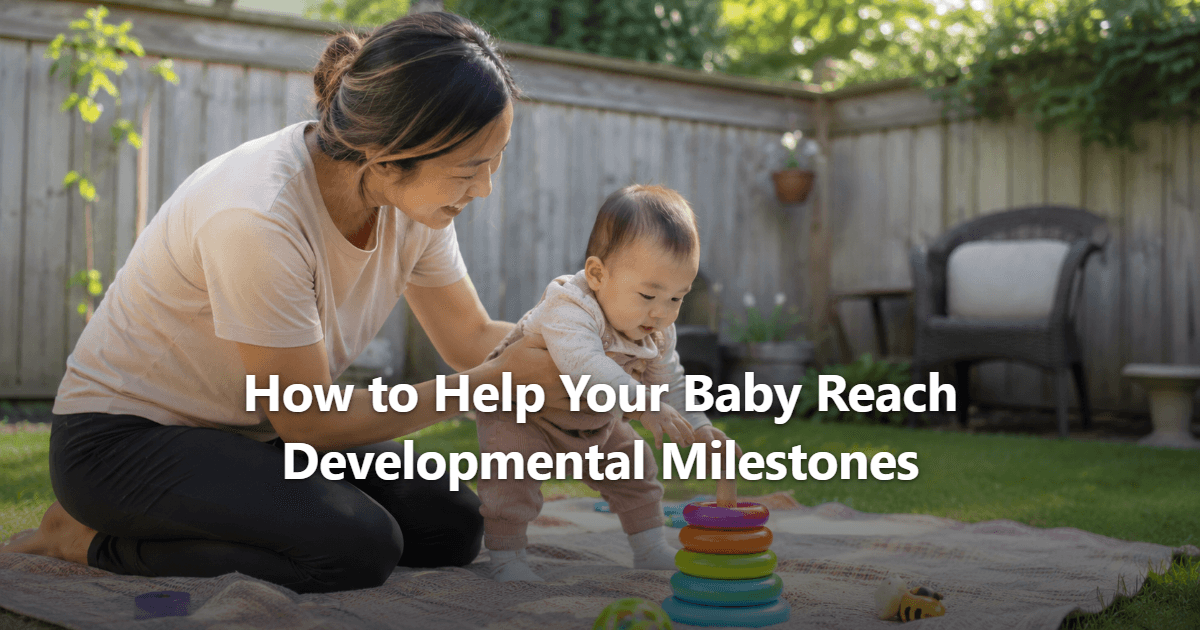
How to Help Your Baby Reach Developmental Milestones
Wondering if you're doing enough to help your baby hit milestones? Learn practical, science-backed ways to support your baby's development every day.
Read Morearrow_forward
How to Know If Your Baby Is Hitting Their Milestones
Wondering if your baby is on track? Learn what milestones really mean, how development unfolds, and when to talk to a professional.
Read Morearrow_forward
Is Your Baby Hitting Their Milestones
Worried your baby is on track? Learn how to read baby milestones with confidence across movement, communication, and sensory development.
Read Morearrow_forward